Articles
 16 Dec 2025
 3 min. read
Introduction
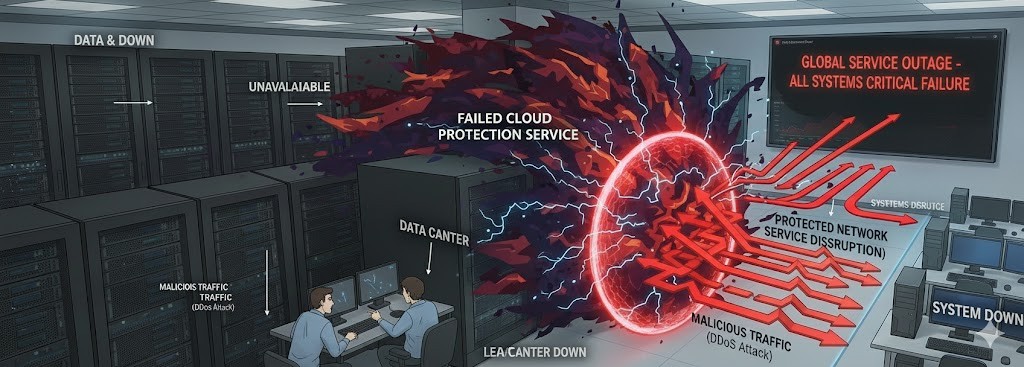
On November 18, 2025, an error in the core systems of a global cloud-based security and CDN provider caused a major outage affecting millions of users worldwide. A change in the bot management system caused a feature file to grow unexpectedly, leading to devices being unable to process this file and throwing errors. Because this file propagated through the entire global network of the provider, the outage was felt on a global scale. Tens of thousands of services, including major platforms like ChatGPT and X, became inaccessible with 5xx error codes. For a corporate user, this disruption can be defined as a supply-chain-sourced cyber resilience vulnerability.
What Did This Incident Demonstrate?
This outage showed that over-reliance on a large-scale infrastructure provider—specifically the consolidation of CDN + security layers at a single point—is a serious risk. With the collapse of this global provider, the entire service chain, including WAF, CDN, bot protection, and DDoS protection, crashed simultaneously. This event clearly demonstrated the impact of the risk that the World Economic Forum has highlighted for years under the heading of “collapse of critical information infrastructure.” For many companies, this situation created an effect similar to a DDoS attack: the service is inaccessible.
Why Should HARPP DDoS Mitigator Be Positioned at This Point?
Independent and Local Protection: The services provided by global cloud-based security and CDN providers are outside of your control. When an outage occurs, what can be done is limited. HARPP DDoS Mitigator provides a completely local and independent layer. Even if the cloud collapses, HARPP continues to work.
Ownership: HARPP DDoS Mitigator works on-prem, meaning in your own rack. It is not shared; it belongs to you. You are not affected by attacks targeting other tenants as in shared systems.
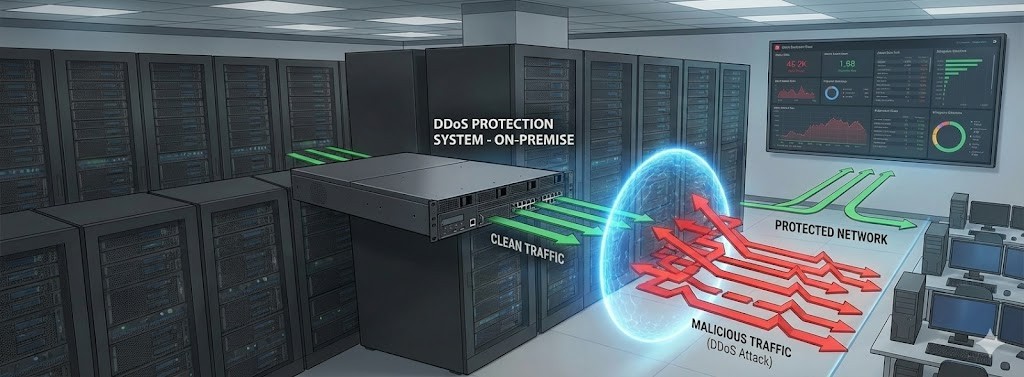
Hardware-Based Fastest Reaction to DDoS Attacks: The HARPP device operates inline, analyzing incoming traffic instantly and filtering at hardware speed. This provides faster reaction with lower latency than cloud-based solutions.
Real-Time: HARPP DDoS Mitigator does not rely on threshold values and does not wait for a trigger to activate. Being constantly active, it blocks almost every attack packet in real-time before it reaches the service.
Respects Data Regulations: Global providers see your data. They can even see encrypted data, often through SSL termination functions. However, data protection regulations often prohibit foreign parties from seeing data or require bureaucratic permissions. HARPP DDoS Mitigator performs DDoS mitigation with on-prem solutions without your data leaving your network.
Conclusion
The outage experienced by a global cloud-based security and CDN provider on November 18 showed that:
- Dependency on a single global cloud provider is risky.
- You need to be unaffected by attacks targeting others.
- Since such outages can create a DDoS effect even if they are not a real DDoS, they should be evaluated as high risk in corporate cyber risk analyses.
- A local, inline, independent DDoS mitigation system like HARPP guarantees service continuity during outages.
- HARPP is a lower-risk alternative compared to similar cloud-based solutions. HARPP can protect all traffic on its own by providing L3–L7 level inline DDoS protection at hardware speed. Protection continues even if cloud solutions crash or become inaccessible.
The Winning Solution
By creating a hybrid architecture together with the volumetric protection of your local ISP, HARPP helps eliminate the risks carried by anti-DDoS cloud services offered by global providers and brings your organization to a structure fully compliant with data regulations. In this hybrid solution, the ISP provides volumetric protection and global edge/CDN advantages, while HARPP provides a local and independent security layer within the institution.


RECENT Articles


The November 18 Outage: The Importance of Independent Protection for Cyber Resilience
Introduction On November 18, 2025, an error in the core systems of a global cloud-based security and CDN provider caused…
3 min. read
The Critical Risk of DDoS Attacks in Healthcare: Proactive Mitigation with HARPP DDoS Mitigator
In today’s digital landscape, where cyber threats are becoming increasingly complex and pervasive, traditional security models that rely on perimeter……
13 min. read
Facts on Cybercrime Threats in Turkey
As the use of internet increases, so does cyber crime. With no or less protection on a website, the access…
3 min. read